Portugal D8 Digital Nomad Visa: A Comprehensive Guide
What is digital nomad visa?
“Digital nomads” represent a lifestyle trend that has gained prominence in the 21st century. With the advancement of information technology, an increasing number of professionals—such as IT workers, media personnel, language teachers, and freelancers—have broken free from traditional office settings. They now have the ability to work remotely from any location worldwide with internet access. This concept of remote work gained significant traction, especially before and during the pandemic.
Once liberated from office constraints, some remote workers choose to embrace a unique lifestyle: they carry their bags and travel to various destinations while continuing to work remotely. These individuals, known as “digital nomads,” experience a blend of exploring new cultures and working from different corners of the world.
To attract digital nomads and promote tourism and emerging industries, governments in at least 65 countries and regions worldwide have introduced specialized digital nomad visas. These visas typically have the following characteristics:
1. Applicants must be remote workers with stable monthly income and cannot be employed locally.
2. Digital nomad visas are essentially extended travel visas, often valid for one year and allowing residence for up to two to four years in the destination country without the option for permanent immigration.
However, in some Latin American and Southern European countries—such as Portugal, Spain, Uruguay, and Ecuador—digital nomads can eventually obtain local permanent residency or even naturalization after accumulating a certain length of stay.
For more information on digital nomad visa programs, explore the details in our “Global Digital Nomad Visas | An Incomplete Handbook” on this websites.
Portugal Digital Nomad Visa: An Overview
If you’ve been dreaming of trading your home office for a seaside café in the Algarve or a trendy coworking space in Lisbon, the D8 Digital Nomad Visa is your official golden ticket.
Updated for 2026, this visa is specifically designed for remote workers, freelancers, and business owners whose income comes from outside Portugal. Here is everything you need to know about the requirements, the process, and choosing the right path for your lifestyle.
Two Routes: Temporary Stay vs Residency
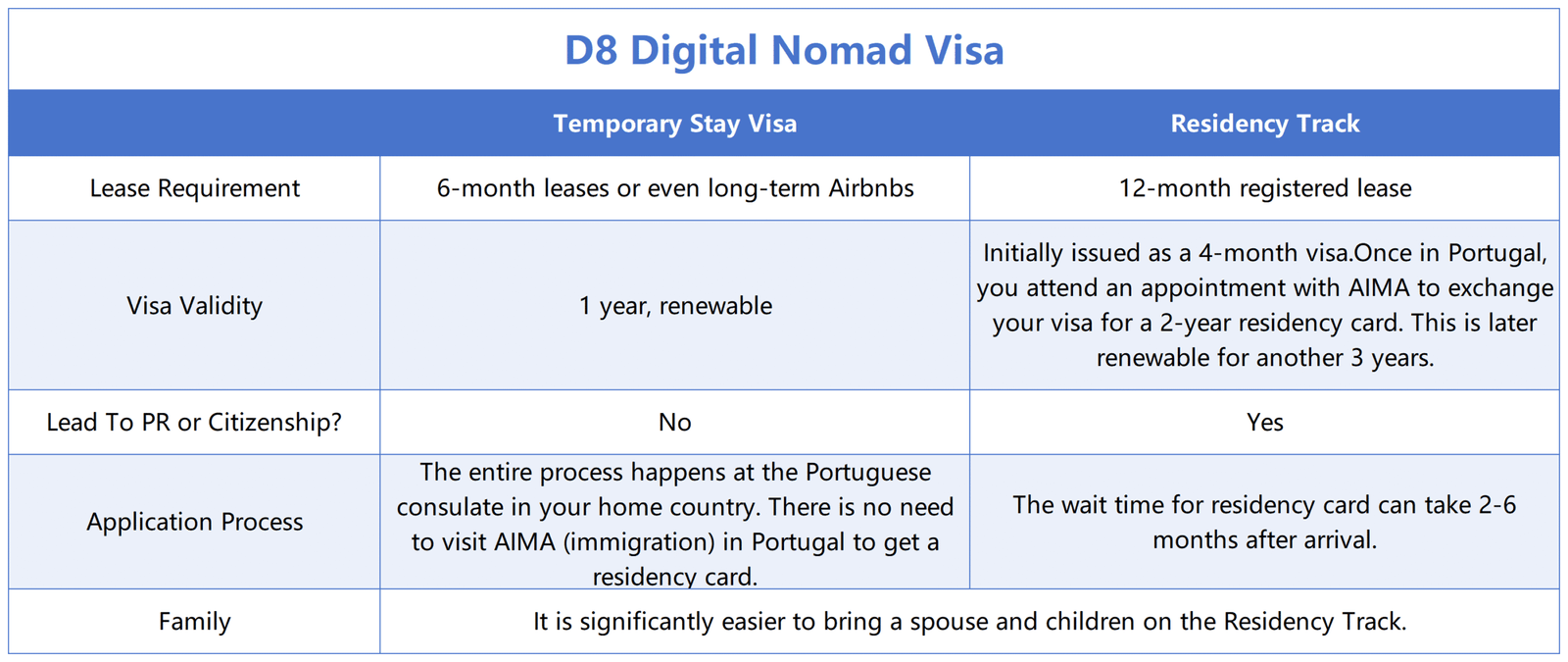
Applicants generally have two options when applying for the Digital Nomad Visa:
1. Temporary Stay Visa (Short-Term): This option is suitable for remote workers who want to live in Portugal for up to one year without committing to a long-term residency path. It allows for multiple entries but does not lead to a residence permit, permanent residency, or citizenship.
2. Residency Visa (Long-Term): This is the more popular route for those planning a long-term stay. It is initially issued for four months (allowing two entries into Portugal). Crucially, this visa enables the holder to apply for a Temporary Residence Permit upon arrival in Portugal, which opens the path to permanent residency and citizenship.
Financial Requirements:
The most important factor for the D8 is your monthly earnings. Because the Portuguese national minimum wage increased to €920/month in January 2026, the D8 income bar has risen accordingly.
Minimum Monthly Income: You must prove a recurring gross income of at least €3,680 (which is 4x the national minimum wage).
Savings: In addition to your monthly salary, you should show a “safety net” of at least €11,040 (12 months of minimum wage) in a bank account.
Dependents: If you are bringing a spouse, add 50% to the savings requirement; for each child, add 30%.
Remote Work Requirements:
Applicants must prove their status as a legitimate remote worker or freelancer:
For Employed Remote Workers: You must provide an employment contract, a recent pay-stub, and a declaration from your foreign employer stating that the employee is authorized to work remotely from Portugal.
For Freelancers/Self-Employed: You must provide proof of service contracts with clients, a letter of intent to contract, or documentation demonstrating business ownership and consistent income from foreign clients. The income must be verifiable through bank statements.

Benefits and Quality of Life:
The D8 Visa grants significant benefits that make it highly attractive to remote workers:
Schengen Area Travel: As a resident of Portugal, the visa holder gains the right to visa-free travel throughout the Schengen Area for up to 90 days within any 180-day period.
Family Reunification: The visa includes provisions for family reunification, allowing the main applicant to bring a spouse, minor children, and dependent parents to live in Portugal.
Access to Services: Holders of the residence permit gain access to Portugal’s public healthcare and education systems.
Tax Benefits: Digital Nomads who become Portuguese tax residents may be eligible to apply for the Non-Habitual Resident (NHR) tax regime. While this regime is undergoing changes, it historically offered significant tax benefits, including exemptions on certain types of foreign-sourced income for a ten-year period.
Lifestyle: Portugal offers an appealing quality of life with its mild climate, safety, low cost of living compared to other Western European nations, and a thriving international community, making it a top global destination for remote professionals.
Application Process:
Phase 1: Preparation Before Application
Before you submit your application, you need to gather several key documents and fulfill important prerequisites:
Secure a Portuguese Tax ID (NIF): This is the Número de Identificação Fiscal and is essential for almost any official or financial activity in Portugal, including opening a bank account and securing accommodation. You can obtain this remotely through a legal representative or in person.
Open a Portuguese Bank Account (Recommended): While not always strictly mandatory for the visa application, it’s highly recommended to open one and deposit proof of funds (typically your required savings) into it.
Secure Accommodation: You generally need to provide proof of long-term accommodation, such as a 12-month lease agreement or other official documentation for your stay in Portugal.
Gather Essential Documents:
- Valid Passport: Must be valid for at least six months beyond your intended stay.
- Proof of Remote Work: This could be an employment contract, freelance contracts, or client agreements showing you work remotely for a non-Portuguese entity.
- Proof of Income: Bank statements (usually for the last 3-6 months) showing a consistent monthly income of at least €3,480 (this minimum is generally four times the Portuguese minimum wage and can change, so check the current figure).
- Proof of Savings: Bank statements showing sufficient savings, typically at least €10,440 (12 months of the minimum wage).
- Health Insurance: A policy valid in Portugal with a minimum coverage of €30,000 for medical expenses and repatriation.
- Criminal Record Certificate: A clean criminal record certificate from your home country (and any country you’ve resided in for over a year in the last five years). This usually needs an Apostille and may require translation into Portuguese.
- Motivation Letter: A letter explaining your reasons for moving to Portugal and your intent to live there as a digital nomad.
Phase 2: Submitting Your Visa Application
The application for the initial D8 visa is done outside of Portugal.
1. Complete the National Visa Application Form: This form is available from the Portuguese consulate or embassy website in your country of residence.
2. Book an Appointment: Schedule an appointment at the Portuguese Consulate, Embassy, or a third-party visa application center (like VFS Global) in your country of residence that has jurisdiction over your area.
3. Submit Your Application: Attend your appointment and submit the completed application form, along with all the required supporting documents you gathered in Phase 1. You will also pay the non-refundable visa application fee.
4. Await Processing: The consulate will process your application, which can typically take between 15 to 60 days, though processing times vary. They may request an opinion from the Portuguese Immigration and Border Services (AIMA, formerly SEF).
Phase 3: Arrival in Portugal and Residency Permit
If your application is approved, you will be granted a Residence Visa that is typically valid for four months and allows for two entries into Portugal.
1. Travel to Portugal: Enter Portugal using your new D8 visa.
2. Apply for a Residence Permit: The D8 visa is a long-term visa that allows you to apply for a Residence Permit once you are in Portugal. You must schedule and attend an appointment with AIMA (Agência para a Integração, Migrações e Asilo)—the Portuguese immigration authority—within the four-month validity of your entry visa.
3. Attend the AIMA Appointment: At this appointment, you will submit a new application for the Residence Permit, provide your biometrics (fingerprints and photo), and present the original copies of your supporting documents (many of the same ones from the visa application). You will also pay the residence permit processing fee.
4. Receive Your Residence Card: Once approved, you will receive your official Portuguese Residence Card, which is usually valid for two years and is renewable.
Visa Validity:
The D8 visa’s long-term option offers a direct route to gaining long-term status in Europe:
The initial two-year Temporary Residence Permit can be renewed for an additional three years.
After five years of holding a D8 permit, you can apply for Permanent Residency. You’ll need to live in Portugal for at least six consecutive months each year—or eight months total if spread out—and once you secure PR, the rule relaxes. You only need to visit once every two years to keep your PR active.
In the past, the five-year “clock” started the moment you submitted your application. Now, the clock only starts once you have the physical card in your hand. With current backlogs, this could add a year or two to your total wait.
As for Portuguese citizenship, we’re currently in a transitional phase. Parliament has approved a bill to extend the requirement from five to ten years (or seven for Portuguese-speaking nationals). But as of March 2026, you can still apply after five years of legal residence.